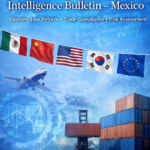

Mexico · United States · Canada · Asia · Global
Executive Summary | Reference Week 7 | Wednesday 11-02-2026
SEMUDMEX – Strategic Customs & Trade Advisory
MEXICO – Customs & Compliance (New Developments)
• Effective Feb 1, 2026: extended timeline for cancelling deposits in customs guarantee accounts (estimated value cases) (Lexology summary of Mexico Customs Law amendments (Nov 2025) – effective date Feb 1, 2026)
Operational Explanation: For definitive imports declared below the authority’s estimated price, the term to cancel deposits in customs guarantee accounts is extended from 6 to 12 months. This changes cash-flow and compliance timelines in value-risk operations.
SEMUDMEX Practical Risk Assessment: Importers with recurring estimated-value exposure should recalibrate treasury planning and ensure their valuation evidence is audit-ready for a longer window.
• Upcoming April 1, 2026: guarantee-account requirement expands to Strategic Bonded Warehouses (RFE) (Lexology summary of Mexico Customs Law amendments (Nov 2025) – effective date Apr 1, 2026)
Operational Explanation: The reform incorporates the obligation to guarantee the introduction of goods into RFE through a customs guarantee account, increasing entry requirements for users of strategic bonded warehousing schemes.
SEMUDMEX Practical Risk Assessment: Projects relying on RFE should validate eligibility, costs and lead-times now; otherwise, shipments risk holds or re-routing into less efficient regimes.
• Mexico–Portugal maritime corridor (Sines–Coatzacoalcos) gains relevance as Europe-facing alternative route (Nowports Weekly Logistics Summary (Jan 2026); Mexico–Portugal cooperation protocol (as reported))
Operational Explanation: Beyond logistics, this corridor implies new multimodal documentation sets (ocean + rail) and tighter origin / transit discipline if the Isthmus becomes a true Europe gateway.
SEMUDMEX Practical Risk Assessment: Companies using the route must align Incoterms, transit controls and supporting documents to prevent mismatches that trigger customs holds or post-clearance adjustments.
UNITED STATES – Tariffs, CBP Operations & Enforcement
• U.S. House vote opens path to challenges against Trump-era tariffs on Canada (Reuters (11-02-2026); Financial Times (11-02-2026))
Operational Explanation: The House narrowly rejected a procedural rule designed to shield tariffs from congressional review, enabling near-term votes to roll back tariffs on Canadian goods. Regardless of outcome, the signal is policy volatility and litigation risk around tariff authority.
SEMUDMEX Practical Risk Assessment: Trade planning should treat tariff rates as unstable inputs: update landed-cost models, contract clauses (price adjustment) and contingency sourcing.
• U.S.–Canada trade tension escalates into infrastructure leverage (bridge opening threat) (Reuters (10-02-2026))
Operational Explanation: Threats to block or condition the opening of a major cross-border bridge move beyond rhetoric: they introduce operational risk at key North American logistics nodes.
SEMUDMEX Practical Risk Assessment: Mexico-based exporters serving Canada/US corridors should stress-test routing, transit times and inventory buffers for sudden policy-driven disruption.
• CBP shifts certain refunds to electronic payments starting Feb 6, 2026 (CBP Customs Bulletin Vol. 60, No. 3 (21-01-2026))
Operational Explanation: CBP announced it will issue refunds electronically (with limited exceptions). This is operational but impacts importers’ finance workflows and reconciliation cycles.
SEMUDMEX Practical Risk Assessment: Ensure broker/importer banking data, authorization and reconciliation controls are aligned; otherwise refunds can be delayed, misapplied or disputed.
GLOBAL – Critical Minerals: Strategic Control of Supply Chains
• U.S. proposes a ‘critical minerals trade bloc’ with allies to weaken China’s grip (Reuters (04-02-2026))
Operational Explanation: The concept signals coordinated policy on minerals (pricing, sourcing, processing). This will increasingly link trade benefits to documented mineral origin and compliant supply chains.
SEMUDMEX Practical Risk Assessment: Mexican manufacturers should map mineral content in BOMs (especially auto/electronics) to anticipate proof demands under USMCA and U.S. incentive regimes.

• China reinforces rare-earth leverage amid U.S. rivalry; signals tighter control posture (Reuters (11-02-2026))
Operational Explanation: High-level inspections and messaging around rare-earth capability and reporting requirements point to a sustained, strategic use of export controls and domestic coordination.
SEMUDMEX Practical Risk Assessment: Supply disruptions can become compliance failures (origin/value changes, substitution of inputs). Clients need dual sourcing and traceability documentation to protect preferential treatment.
• EU policy analysis highlights extraterritorial reach and supply-chain implications of China’s rare-earth restrictions (European Parliament Think Tank (24-11-2025))
Operational Explanation: EU institutions underscore that China’s controls can carry extraterritorial effects and reshape procurement and reporting expectations for companies using controlled inputs.
SEMUDMEX Practical Risk Assessment: Where clients sell into EU/US markets, inconsistent sourcing narratives can trigger customs scrutiny across jurisdictions; unify supplier declarations and compliance files.
CANADA & ASIA – High-Impact Developments for North America
• Canada tariff rollback debate in the U.S. raises near-term uncertainty for integrated supply chains (Reuters (11-02-2026))
Operational Explanation: Even if tariffs are not immediately reversed, the congressional push introduces uncertainty that affects procurement timing, inventory strategy and pricing for trilateral chains.
SEMUDMEX Practical Risk Assessment: Clients should renegotiate contract language (tariff pass-through) and ensure HS classification/origin files can withstand both customs and political scrutiny.
• China’s rare-earth controls expand beyond metals into processing equipment restrictions (Al Jazeera explainer on China’s 2025 control expansions (crawled recently))
Operational Explanation: Controls increasingly cover not only the metals but also specialized equipment used in refining, tightening the chokepoints for global downstream production.
SEMUDMEX Practical Risk Assessment: Expect longer lead times and higher compliance scrutiny on tech-heavy shipments; plan buffer stocks and document substitution decisions to defend valuation/origin.